VELODROME AND
OLYMPIC SWIMMING POOL
BERLIN
GERMANY, 1992-1999
SPORT
PR–140
Two years after the fall of the Berlin Wall, Berlin, the new capital of reunified Germany, submitted its bid to host the 2000 Olympic Games. An international consultation was launched for the construction of a velodrome and a swimming pool.
PROGRAM
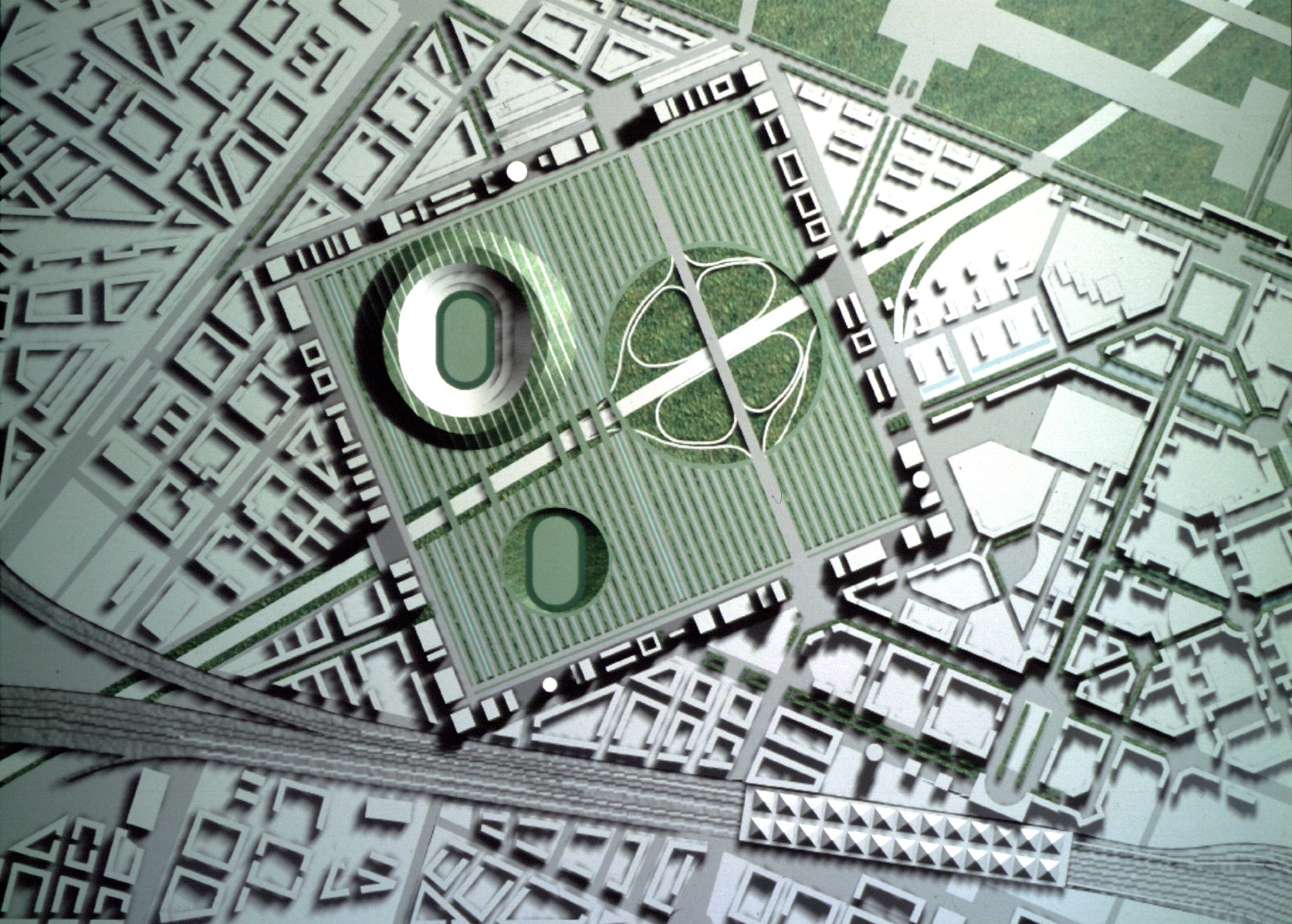
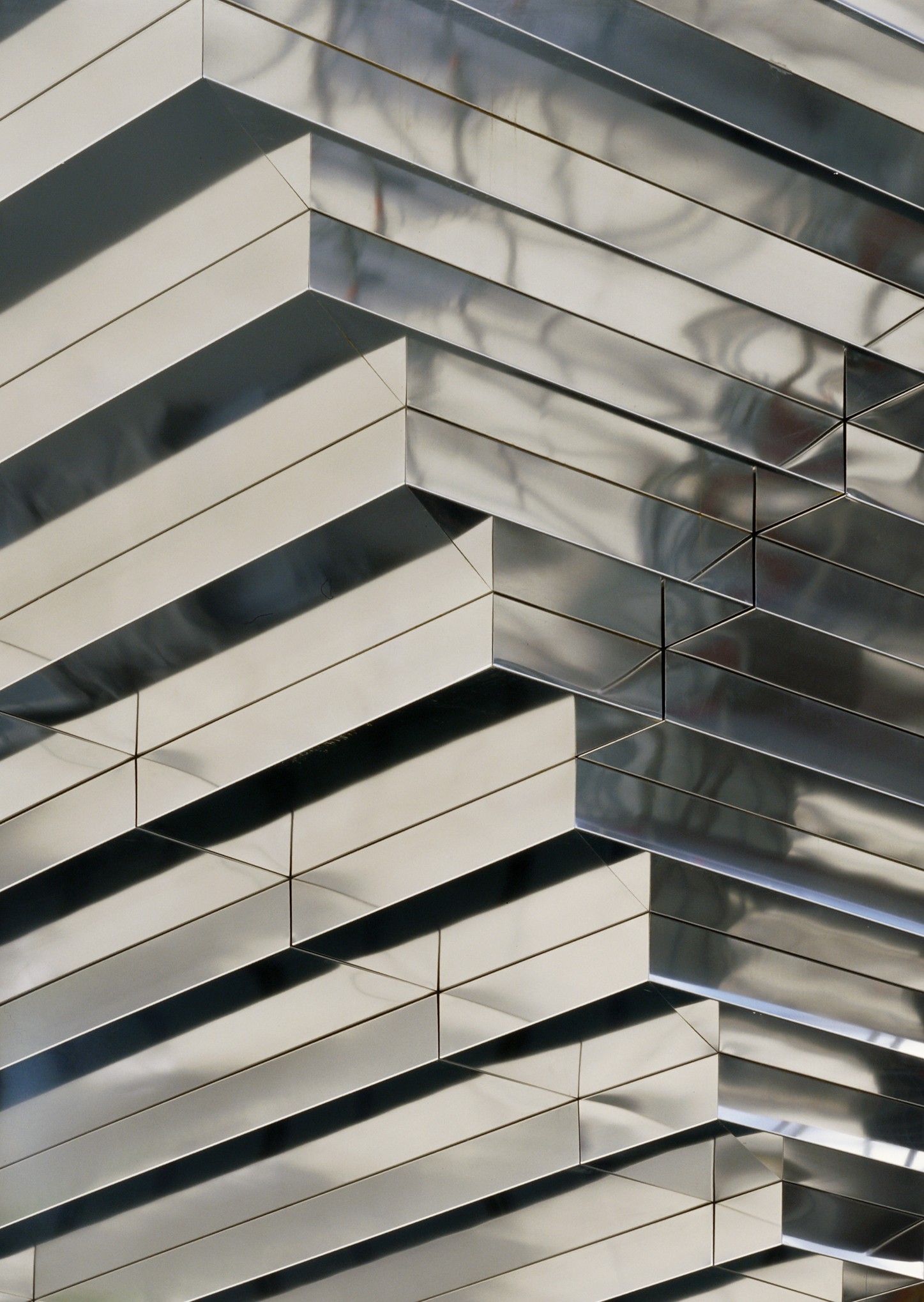
Two facilities embedded in the ground, symbolized by their mirrored roofs, in the heart of an orchard: a circle, the multipurpose Velodrome (29,800 m²): cycling, athletics, tennis, equestrian sports, sports education, concerts (11,420 spectators, 5,583 seats) and a rectangle, the swimming pool (23,980 m²): two pools (4,200 spectators, 2,136 seats), Olympic diving board, diving training pools, pool for people with disabilities, children’s pool; multi-sports hall.
DETAIL
Situation
Landsberger Allee, 13055 Berlin, Germany
Year
1992-1999
Status
International contest, winning project
Site area
10 ha
Built-up area
53 700 m²
Landscaping
Planted orchard comprising 450 apple trees
Project management
City of Berlin, represented by OSB Sportstättenbauten GmbH, Berlin
Project implementation
Dominique Perrault, architect, urbanist
Partner
Rolf Reichert – RPM, SSP-Schmidt, Schicketanz & Partner
Design offices
PROMOS projektmanagement Olympiasportdtätten, Ove Arup & Partners Ltd., IBUS Institut für Bau, Umwelt und Solartechnik GmbH, Fraunhofer-Institut für Bauphysik IBP, Jean-Paul Lamoureux, Landscape plan + build GmbH, Weidleplan Consulting GmbH, Architekt Kerschkamp, Éric Jacobsen
Interior architect and designer
Gaëlle Lauriot-Prévost
DESCRIPTION
The city’s Olympic image was still closely linked to the tragedies of German history and the monumental stadium built by Albert Speer in the Charlottenburg district. Rather than focusing on a pre-established architectural form, the project emphasizes the relationship between the building and its environment. Two simple volumes, one circular and the other rectangular, are located in the heart of a vast 200 × 500 m park. Veiled by a metal fabric that vibrates with the sunlight, the velodrome and swimming pool give the impression of disappearing, taking on the appearance of real bodies of water. Finally, nearly 450 apple trees imported from Normandy, known for their hardiness—vegetation capable of withstanding the harsh Berlin winter was needed—have been planted in this park, designed as an orchard, adding a touch of poetry to the new sports complex.
READ MORE
Inside, every geometric detail contributes to the choreography of the spaces. A row of industrial spotlights focused on a gallery, a line of swimming lanes, a hedge of metal grid tiles, black and white edges in the changing rooms marking the walls, a succession of wooden seats—the entire geometry of the space is in competition. The velodrome sits in the middle of a semicircle of glass facades. The combination of circles and stripes is repeated on the ceilings of the corridors, where round light fixtures are embedded in perforated metal plates that absorb noise pollution. Metal and concrete staircases organize the flow of athletes and spectators. The Olympic pool is reminiscent of the insular look of 1960s sanatoriums. Blue and pink, the predominant colors, exist in isolation and sometimes merge when the color of the pool meets the raw concrete of a corridor or the gray that covers the facades of the circulation spaces. This synchronized swimming of shapes and colors continues in geometry with the diving board. Built like scaffolding, with bridges and walkways, this architectural sculpture evokes the setting of West Side Story, made famous by Maria and Tony’s love scene. As in the movie, the acoustics of the venue are precise, softened by the slanted orientation of the glass walls around the bleachers. In the musical, each of the protagonists climbs up and down the stairs: a kind of choreographed chase. It also resembles a swimming competition.
RELATED PROJECTS
OLYMPIC VELOPARK
PR 340
Sport
London
GROUNDSCAPE
R 002
Research
UN VILLAGE ET SON DOUBLE – MANUEL D’URBANISME
PU 083
Masterplan
Barcelona
SUZANNE LENGLEN COURT COVER
PR 645
Sport
Paris
GRAND STADIUM
PR 067
Sport
Melun-Sénart
KINDARENA – SPORTS ARENA
PR 439
Sport
Rouen
GRANES ÉCURIES
PR 546
Heritage
Chantilly
